Bet the Farm: How Food Stopped Being Food by Frederick Kaufman
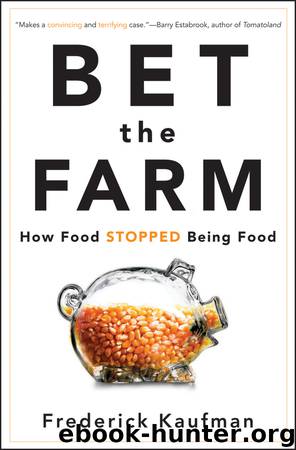
Author:Frederick Kaufman [Kaufman, Frederick]
Language: eng
Format: epub
Tags: General, History, United States
ISBN: 9780470631928
Publisher: Wiley
Published: 2012-09-05T07:31:10+00:00
Chapter 9
The Food Bubble
The next morning in Rome I opened the newspaper to discover that food riots had erupted a few hundred miles to the north. On June 3, in front of European Union headquarters in Brussels, police armed with shields and batons had charged hundreds of protesting fishermen from France, Italy, Portugal, and Spain. The Associated Press reported that as the protesters retreated down the main boulevard, they “broke into EU buildings, smashing windows and dragging out flags and other items to burn in the street.” Next to the AP story, the International Herald Tribune reported that Monsanto had announced a new generation of seeds that required almost one-third less water than ordinary seeds and promised to double yields for corn, soybeans, and cotton.
I opened the Financial Times of London and discovered that billionaire investor George Soros was painting a bleak picture on commodities and was now calling the high prices of corn, wheat, and oil a bubble. “Misplaced investing in indices by institutions is to blame for soaring valuations,” he noted. I thought this was an interesting article.
Soros was saying that something had gone wrong with the commodity markets. The price of food was higher than it should have been. The balance of hedgers and speculators had been lost, normal backwardation was out the window, and the ingenious interplay of the real and the imaginary on the futures exchanges could no longer stabilize prices.
Soros was not saying that the soaring price of food would make farmers, food processors, or even food retailers rich. Nor was he saying that the rising price of food had anything to do with better-quality food. Soros was saying that something had gone wrong with the market for food futures. And he was implying that someone somewhere was making boatloads of money. Of course, that someone, somewhere, didn’t necessarily have anything to do with meat or potatoes. Perhaps that someone was a new kind of speculator in financialized food, someone who had figured out a new way to pump money from the derivatives of our daily bread, the cost of which was rising at unprecedented rates.
Such surges in price are called bubbles. In 1841, Charles Mackay wrote a book called Extraordinary Popular Delusions and the Madness of Crowds, in which he described one of England’s first financial bubbles, the so-called South-Sea Bubble of 1720. “The populace are often most happy in the nicknames they employ,” wrote Mackay. “None could be more apt than that of bubbles.”
It was 2008, and there was a food bubble. I put down the papers and gazed at the Circus Maximus. “It is most unjust that the hunger of one’s own fellow-citizens should be a source of profiteering for anyone,” the Roman consul Antistius Rusticus had lamented two thousand years ago—but nobody listened to him.
I walked past the ancient chariot track and headed over to Mussolini’s old headquarters, where I had scored an interview with Nancy Roman, the World Food Program director of communications and public policy strategy. She and the WFP executive director, Josette Sheeran, went way back.
Download
This site does not store any files on its server. We only index and link to content provided by other sites. Please contact the content providers to delete copyright contents if any and email us, we'll remove relevant links or contents immediately.
Life 3.0: Being Human in the Age of Artificial Intelligence by Tegmark Max(5558)
The Sports Rules Book by Human Kinetics(4388)
The Age of Surveillance Capitalism by Shoshana Zuboff(4293)
ACT Math For Dummies by Zegarelli Mark(4049)
Unlabel: Selling You Without Selling Out by Marc Ecko(3663)
Blood, Sweat, and Pixels by Jason Schreier(3625)
Hidden Persuasion: 33 psychological influence techniques in advertising by Marc Andrews & Matthijs van Leeuwen & Rick van Baaren(3566)
The Pixar Touch by David A. Price(3439)
Bad Pharma by Ben Goldacre(3428)
Urban Outlaw by Magnus Walker(3400)
Project Animal Farm: An Accidental Journey into the Secret World of Farming and the Truth About Our Food by Sonia Faruqi(3221)
Kitchen confidential by Anthony Bourdain(3091)
Brotopia by Emily Chang(3056)
Slugfest by Reed Tucker(3005)
The Content Trap by Bharat Anand(2927)
The Airbnb Story by Leigh Gallagher(2857)
Coffee for One by KJ Fallon(2638)
Smuggler's Cove: Exotic Cocktails, Rum, and the Cult of Tiki by Martin Cate & Rebecca Cate(2541)
Beer is proof God loves us by Charles W. Bamforth(2464)
